Tuesday, April 26, 2011

How To Start Period With Pressure Point

China's defense in the coming years

Each time you see a new power, two key questions are: how many tanks you have? and what intend to do with them? When Wilhelmine Germany wanted to enter the league of great powers in the early twentieth century, one of his tools were the battleships. The more you have, the stronger would be more appropriate and would make it. The result was that the more armor, more and more distrusted Britain is snuggled up to France and Russia. Some in France and Britain realized that Hitler had taken the guise of lamb on the day they discovered that Nazi Germany was rearming. Now, at the dawn of the XXI century, the country whose weapons of concern is China.


On March 31, China published its White Paper national defense, that when it became a bestseller among defense analysts. It is the seventh edition of a publication that since 1998 is being launched on a biannual basis.


first thing to do in these documents is to present what is the status of the situation in which one has to unfold. The document begins by saying that is "peaceful and stable " and " the current trend towards peace, development and cooperation is irresistible. But international strategic competition and contradictions are intensifying global challenges are becoming more prominent and security threats are becoming more integrated, complex and volatile . "Please, somebody redefined the term" peaceful "and" stable. "


The security situation in Asia-Pacific is perceived as stable, with the development of common interests and the persistence of multilateralism, of which examples that stands out is the Shanghai Cooperation Organization, established in the form of spit to the U.S. . Again, the editor of the paper shows that his concept of "stable" leaves much to be desired, he writes: " The security situation in Asia-Pacific region is becoming more intricate and volatile. "The specific problems identified are: the Korean Peninsula, Afghanistan, the disputes over the demarcation of territorial waters (no names mentioned, but it is an issue that China faces with half Asia), terrorism and separatism.


The White Paper also hints that the U.S. believes China will play the nose. He notes that " U.S. is strengthening its regional military alliances and increasing its involvement in regional security affairs ." The reading of this is that the U.S. is getting where he was not called. The appreciation China is interesting. Other countries, such as Singapore, instead regarded with concern that the U.S. is disengaging from Asia.


For all the fear that China's rise raises, the White Paper sets priorities that are essentially defensive: 1) peaceful development of relations with Taiwan. The movement for Taiwan independence is seen as a separatist and a threat to the peaceful development of relations between China and Taiwan. The paper notes that " Further progress in the close relationships [referring to the strait that separates China from Taiwan] is still hampered by some complicating factors. "The U.S. is been called many things, but what they decried as "complicating factor" I love it, 2) Preserving the integrity of China, which is threatened by separatist movements in Xinjiang and Tibet; 3) The suspicion that China wakes up and has led to an increase external interference. This defensive approach and a little paranoia reminds me of the defunct USSR.


armed forces are set targets in line with perceived threats, and added one that I liked it, " Keep social harmony and stability." Assume some functions that suggest if not will have become an NGO development aid and another a little more ominous: " Assuming the maintenance of social stability as a whole as a critical task, the armed forces subject to resolution all subversive activities and sabotage by hostile forces, as well as terrorist activities ." While, yes, they will under the law and the dictates of government and imbued with the proper ideology, because the book also addresses the ideological education of soldiers. If someone were to organize a new Tiananmen happens, you know that army tanks will be there to stop it.


Like any rising power, China aims to have a brand new and modern armed forces. It wants above all mechanized and computerized. It also wants to improve their logistics, an area where they always had gaps. Slightly more worrying is that we also want to increase their outreach capacity, or whether they can make milk out of their neighborhood. It is interesting to think that Chinese ships operating in the Gulf of Aden and the coast of Somalia to combat piracy. The last time Chinese vessels penetrated so far from its shores was the beginning of the Ming dynasty in the fifteenth century. Something is changing.


China aims to achieve the same overlap between the defense industry and the civilian world that exists in America, so that advances in military technology is enjoyed by the civilian economy. The idea sounds brilliant, but to wait to discover what is the lobby of the defense industry.


Anticipating criticism, the White Paper says that the level of expenditure has been kept to a reasonable level. Defense spending has gone from 8'66% of state spending in 1998 to represent the 6'49% in 2009. Before welcomed because the participation of the defense in state spending has dropped, it must be remembered that in those 11 years China's economy has grown at over 8% annually, meaning that the 6'49% represents a much 8'66% higher than 1998. The amount is divided into almost equally between spending on personnel, maintenance and equipment. By comparison, the U.S. spends 20% of its budget on defense. Overall U.S. is the biggest spender on defense with 663,000 million dollars. China comes in second place with 99,000 million, up 15% of what the U.S. spends. If we compare the expenditure to GDP, we see that China spends on defense 2% of GDP. There are 49 countries in the world that spent in 2009 proportions of GDP higher than that of China. In other words, we must recognize that China's defense spending is restrained.


China has learned from past experience that a rising power that should not scare too. The final part White Paper is devoted to highlighting how peaceful and kind that is China. So, remember that since 1993 China has signed a treaty with India so as not to be castrated at the border, which ended in 1996 and 1997 Agreement on confidence-building measures and reduction of military presence on the border with Kazakhstan, Kyrgyzstan Russia and Tajikistan, which in 1998 signed a border agreement with Bhutan in which he said he was not the same thing happen to Tibet (well, it does not say so explicitly, but it is understood), which have border agreements with Russia, Mongolia Kazakhstan, Kyrgyzstan, Burma and Vietnam. Splendid, but the point is that today day China gets more afraid of their neighbors in the water than on land.


The South China Sea is now a hotbed of territorial disputes. There are islands like the Spratleys that look like they were put there solely to the States of the region will cake for them. The White Paper points out that China respects scrupulously the Law of the Sea and remember the agreements it has with countries like USA, Vietnam and Japan. Reading between the lines, it is noted that these agreements are much less all-encompassing than those on land borders.


The White Paper includes all multilateral security initiatives in which it participates China: Shanghai Cooperation Organization , ARF, ASEAN + 1, ASEAN + 3, ASEAN Plus Defense Minister's meeting (ADMM +), Security and Defence Dialogue China-ASEAN Dialogue Shangri-La. I suspect that this proliferation of security and defense initiatives intended to have military establishments of the countries so busy, nobody has time to prepare for war.


In short, this is a balanced and sensible document that looks like a bikini: it reveals a lot, but we hide the details that most interest us.

Monday, April 25, 2011

How To Make Snow Plows For An Rc

get off the tiger


be the ruler in a dictatorship is a bit like riding a tiger. Keep riding his hard hump, but can be done. The really hard part is getting out of it.

The former Burmese dictator Ne Win experienced the truth in their own flesh. When in the summer of 1988 the Burmese people took to the streets to protest against the military dictatorship, Ne Win resigned from their positions as President of Burma and Chairman of the Burma Socialist Programme Party (BSPP). The impression is that its removal was purely cosmetic, to try to appease the protesters, and in fact continued to manage the reins of power from the shadows. In fact many think it was Ne Win who orchestrated the bloody crackdown in September 1988 when the army fired indiscriminately at protesters.

Given the secrecy with which the Burmese generals work, it is difficult to know when the power of Ne Win began to fade. By the late 90's, it was clear that sending less. His advanced age and the rise of Than Shwe, who never stopped to accumulate power, were decisive.

In March 2002 an obscure incident took place when authorities announced they had uncovered a plot to overthrow Board, organized by the son of Ne Win, Aye Zaw Win. We found that the conspirators had a dangerous arsenal consists of 27 rubber batons, two minesweepers and a pistol and had sought the assistance of an astrologer and an expert on black magic. Immediately Ne Win and his daughter Sandar Win, wife of Aye Zaw Win was placed under house arrest. In September of that year, Aye Zaw Win and his three sons were sentenced to death by hanging for the crime of high treason. The sentence was never applied, but since 2002, Aye Zaw Win and his sons are in Insein prison. Ne Win died in December 2002. The official press release just published a brief obituary and his funeral took place in privacy.

was never entirely clear what had been behind the pantomime of the conspiracy. There was talk of conflicts of business interests. Also said that Than Shwe had wanted to send a message to potential rivals within the military junta, which may seek to wrap up the mantle of Ne Win. In any case, Than Shwe made it clear that a dictator is always dangerous to remain so. And now in 2011, Time has come to apply the lesson.

A reading of recent political changes in Burma Than Shwe would be preparing his retirement and making sure that neither he nor his family I will do the same thing he did to Ne Win and his family. I think there are other factors at play, but that is not negligible and it helps explain some things.

Than Shwe meets this year 78, 16 more than the Burmese media. Interestingly, in nearly 20 years that has been most il capo di tutti capi has not bothered to prepare a successor. At different times analysts have thought that this or that general was particularly close to Than Shwe and can you were preparing for the succession, but each time those expectations were dashed. Among the generals who have sounded as potential successors include Maung Aye, Shwe Mann and Thura Myint Swe. I think all the speculation about a successor or another are free. Than Shwe does not really want to appoint a successor. Prefer to leave the country forward to a collective leadership, so that not a single general to accumulate all the power, as has happened with him and, above all, that generally take with your family.

The system created by the 2008 Constitution, which now takes its first steps, is complex and seems designed for two things: that the military did not lose control of the situation and no one can exercise absolute power. It is a system of checks and balances, but Montesquieu or democracy.

To begin creating the Defense Council and National Security, with which the President must "coordinate" on a number of serious matters, such as breaking diplomatic relations with a third country or a state of emergency. The Constitution is not clear how one must understand the word "coordinated." You may want to say that the President should give his heels and stay at attention.

The Council of National Security and Defense is composed of the President, Vice President, Speaker National Assembly, the Speaker of the Assembly of Nationalities, the Commander in Chief of the Armed Forces, Deputy Commander in Chief Armed Forces, Minister of Defence, the Minister EAA, the Minister of Interior and Minister of Frontier Affairs. This list does not lead to mislead and to suggest that the Commander in Chief is a mere primus inter pares, he appoints the deputy commander in chief and who introduced the President paths slates to choose from among them the Minister of Defence, Interior and Border Affairs. That is, the other ten members of the Council, four at least directly or indirectly owe their appointment.

In principle it would seem that the President is capitidisminuido against the commander in chief and it is true, but it is a dog that you have removed all the teeth. We have made some and can bite. The President is elected by an Electoral College Presidential. The parliamentarians from the armed forces make up a third of the Electoral College. Under present conditions in which the ruling USDP is composed of former military officers linked to the former military junta, Than Shwe had no problems when choosing who he wanted as President. But would a scenario in which two-thirds of the Presidential Electoral College decide to vote against the candidate of the military and were imposed.

The Constitution gives the President sweeping powers. He appoints the government, except in the case of the three ministries mentioned whose appointment by the President. The President is part of the main bodies State: Council of National Security and Defense, chaired, and the Finance Commission. Designates a series of charges, including members of the Election Commission or the Attorney General. Has broad powers to cesarlos, still requires the approval of Parliament. In contrast, the impeachment of the President is complicated and difficult to get majorities.

The Chairman is marked by its two Vice-Presidents, which he did not choose, but are elected by Parliament. In addition there is the joke that should allow Vice-President in charge of financial and budgetary matters of the Union and one of the states.

The feeling that I leave this system is as follows: the Commander in Chief is who has the last word, but on condition that it is a universally respected person and no one dares to cough. This condition is applied to Than Shwe. Than Shwe has also ensured that the position of Chairperson being Thein Sein, who is completely loyal, it is not known if lack of personality, interest or folly. Possibly by a combination of the three. The Vice Presidents are also people who can not be expected problems: General Tin Aung Myint Oo, who was the Prime Minister of the former military junta and Muak Sai Khan, a doctor with no political weight shan passing and there have got to show that the military is also concerned about ethnic minorities.

This system will run smoothly while alive Than Shwe, but I think a successor who lacks strength and the President will leave zappy, might run into problems. Enough to not have time to put sticks in the wheels to the family of Than Shwe.

Perhaps, after all, Than Shwe has found a way to get off the tiger.

Monday, April 18, 2011

Trichomoniasis How Long Dormant

My We

Louie Cordero next to a statue. Louie is on the right. Or was it vice versa?


There is an urban legend in the Philippines, said that there was once (or maybe there were many times) a man who was singing" My Way "by Frank Sinatra at karaoke. Rather than sing, the gutting was thoroughly, with a dull razor. Another of those present could not stand it how smashed a beautiful song. He pulled out a pistol and four bullets hit him. I, the judge would have acquitted.

Knowing how passionate they are Filipinos and their love of firearms, the story might even be real. The only thing is I do not block the tune filipino. They have very good hearing. Perhaps he was so drunk that you leave only roosters instead of eighth.

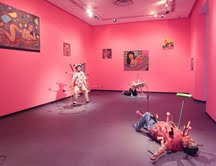
filipino artist Louie Cordero was inspired by this story / urban legend for installation "My We", which was presented at the Singapore Biennale 2011.

The result of his work can only be classified as "kitsch" in its variety cachondona. I do not want to write more on installing, because nothing he wrote could be more fun than the work of Lamb.